
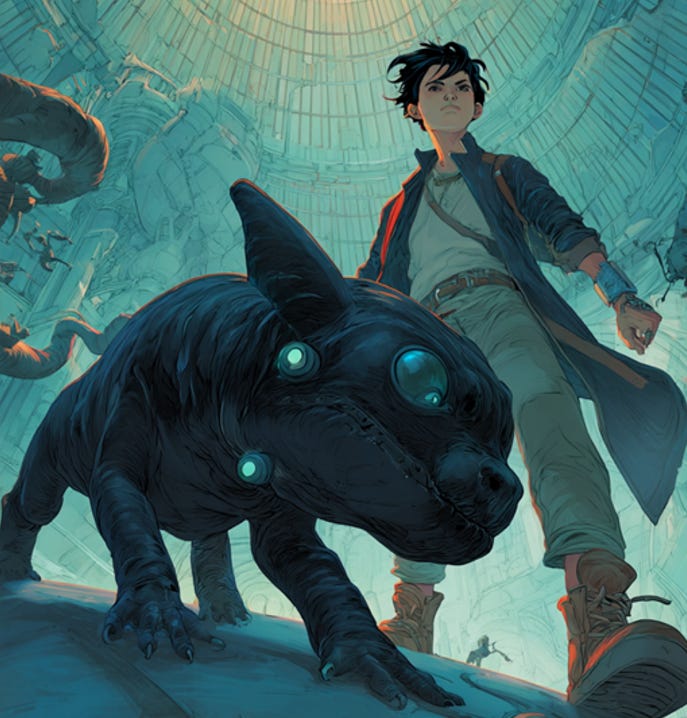
Author James Pyles talks about the scientific inspirations behind his boys’ adventure sci/fi book, A Wobblegong and His Boy. How might one go about genetically designing a boy’s best friend exactly?
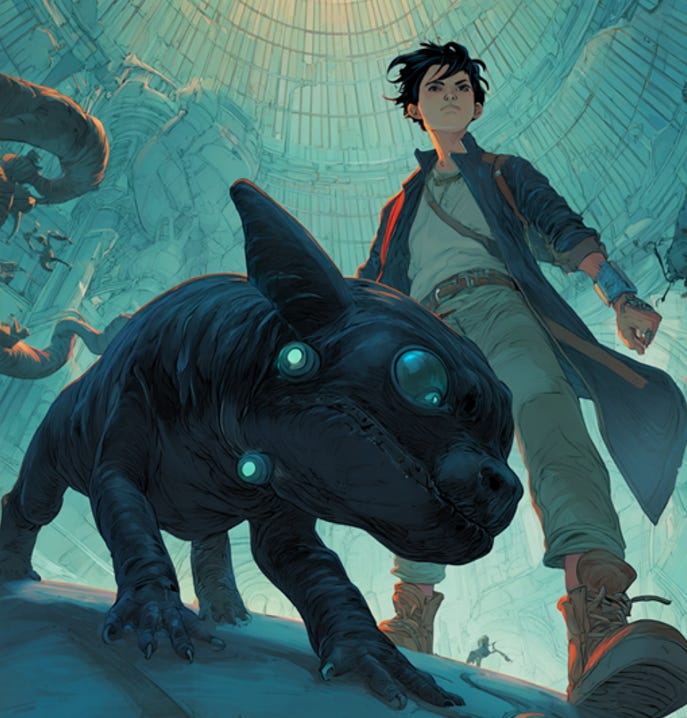
What is a Wobblegong?
That’s one of the most common questions I get whenever someone asks about my book A Wobblegong and His Boy.
The answer requires a bit of history.
Once I get an idea, it’s hard for me to let it go. Once I create a universe, I tend to write short stories that all occur in that same universe. Those short stories accepted for publication end up in various anthologies put out by a number of different presses.
And so it is with a world that has the technology of synthetic DNA.
A number of years ago, I was having a quiet discussion with a friend of mine over coffee. He and I were of a similar age (sadly, he has since passed away), both loved science fiction, and shared a lot of cultural experiences. One of them was the TV show “The Six Million Dollar Man” starring Lee Majors.

Even having read the source material, the novel Cyborg by Martin Caidin, I was never convinced that a bionic person would be able to do all of the things the character Steve Austin did on series. The breaking point in any chain is its weakest link which in this case would be the interface between bionic hardware and a flesh and blood human body.
But what would happen if you took your very injured and almost dead person and instead of rebuilding them with nuclear powered limbs and artificial sensory apparatus, you reconstructed them literally from the ground up mimicking their own genetic code with a synthetic substance? Use thousands or tens of thousands of nano-bots guided by a sophisticated AI to take burned and scarred tissue and seamlessly reform it into its original configuration. In some ways, it would be like a highly advanced form of 3D printing.
But putting a person back together so they were as good as their original self would just be the starting point. What if you could weave in augmentations, improve their senses, strengthen bones, muscles, and nerve tissue, and give them abilities no human had previously possessed? Why, you could adapt a human being to live and even thrive in any number of alien environments. People who could comfortably walk naked on the surface of Mars or swim in the atmosphere of Venus.
The latter idea became my short story “The Colonists” published in the anthology Spring Into SciFi 2020 by Cloaked Press. And thereby hangs my tale regarding Wobblegong.
It’s not abundantly clear in my novel, mainly because I didn’t want it to distract from the main action, but Remmie and his colony, any colony of humans on an alien planet really, are adapted using the above-mentioned technology to live naturally on an alien exo-planet.
I’ve read a lot of articles about the discovery of “Earth-like” exo-planets in our general “neighborhood” of the galaxy, but when those planets are described, they have perhaps five times the mass of Earth, circle a red dwarf star, or have other significant dissimilarities to our own world and solar system.
In other words, unlike the “M-class planets” in Star Trek, it’s very unlikely that you could just drop off a bunch of people on a planet’s surface and have them experience no difficulties with the atmosphere and gravity, be able to eat the native planets and animals, and otherwise live just as they would on Earth.
Terraforming is an option, but adapting an entire planet to suit the needs of people would take a very long time, perhaps centuries. Instead, what if we adapted human beings to the environment so that when they woke up from their reconstruction creches after so many months, the air, gravity, possibly radiation, anything they would encounter would seem perfectly natural and normal to them?
That’s what happened to Remmie and his friends and family and the rest of the colonists in my book.
Except something went wrong with the guiding AI SADI thanks to an unanticipated major solar event. The reconstruction wasn’t complete for everyone except a small group of children and teens. If the other colonists were removed prematurely from those creches, they would be unlikely to survive and if they did, it wouldn’t be for long.
That’s the source of Remmie’s desperation in getting to and repairing SADI.
Now what about Wobblegong?
I originally had the idea of recombining the DNA of a variety of animals, livestock and pets, into a new and alien creature. However, one of the properties that can be used with synthetic DNA is the ability to allow the subject to control their adaptations once they’ve been reconstructed. Taken to the extreme, the subject life form could continuously alter their appearance and abilities to whatever situation it encountered.
Wobblegong started out “life” using the basis of animal DNA from a wide variety of samples but then kept going until it could change almost instantly from a four legs to six, or adapt from a land animal to one that flies or even a water-breather.
When I picture Wobble, I remember those times as a kid when I was playing with iron filings and a magnet, making the filings change shape and orientation. Now imagine that happening to a living being with shapes and abilities being created and recreated on a whim.
That’s Wobblegong.
In my book, I leave it open as to how much of Wobble’s creation was pure accident and how much of it was guided. The story requires thirteen-year-old Remmie to fix a highly complex AI, but even the smartest kid in the world (or worlds) is still a kid.
Near the beginning of the novel, Remmie and his friends are able to “consult” with crewmember Alexander Whitner while he is still in his reconstruction creche. Whitner can communicate enough to provide Remmie with repair instructions which he records on an old-school USB drive. I hint that Whitner may also have influenced the creation of Wobble which Remmie will need to help him not only repair SADI, but after that, to solve a much bigger problem threatening the existence of their entire world.
I’m not going to drop too many spoilers, but the problem with SADI and successfully reconstructing the rest of the colonists is only the beginning. I didn’t want the book to be just another straightforward story of survival and innovation. Remmie needs Wobblegong to help him discover, understand, and then repair something that has gone fundamentally wrong with everything he considers reality.
Sound interesting? It does to me, too.
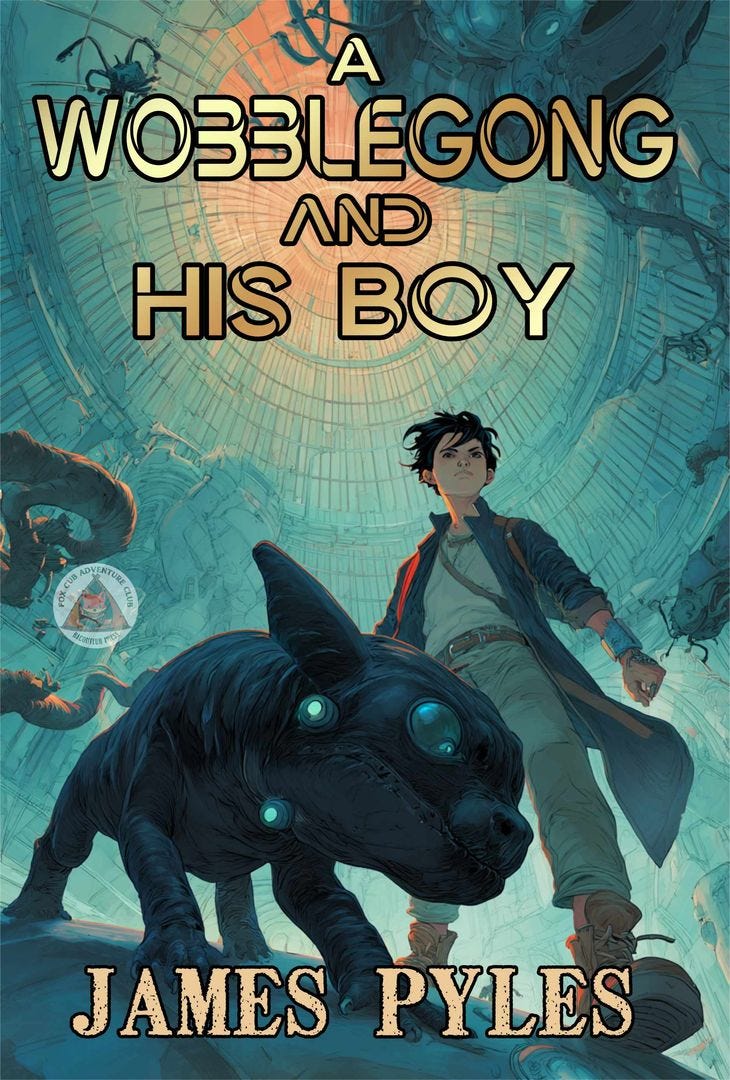
A Wobblegong And His Boy may be written for boys from ages eight to eighteen, but it’s really an exciting science fiction adventure that anyone can enjoy and it operates on a lot more levels than you might think.
Plus it’s a lot of fun.
-James
HOW COOL IS THAT? CHECK OUT A WOBBLEGONG AND HIS BOY!
First published on the Raconteur Press Substack, September 23, 2026.